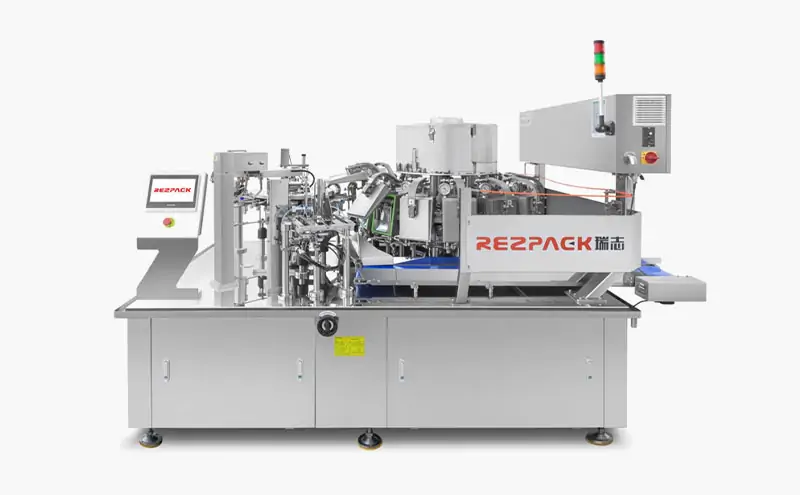
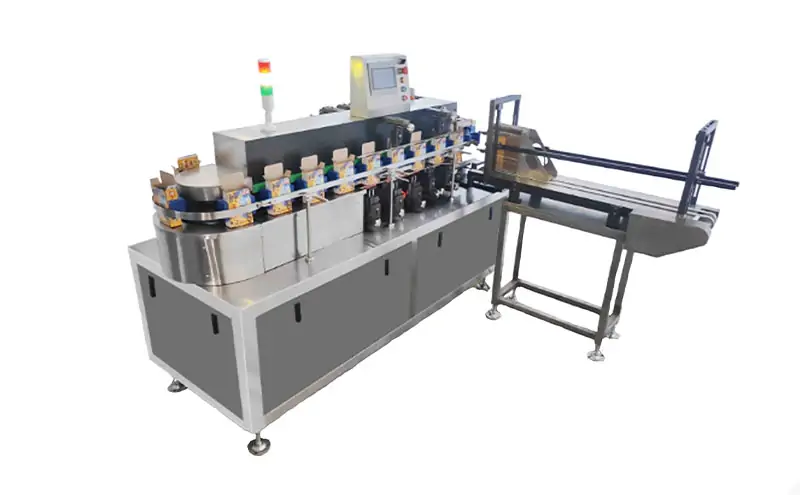
The Cup Form Fill Seal (FFS) machines under our Cup Filling Sealing Line are designed to provide a streamlined and cost-effective solution for packaging a wide range of products such as yogurt, butter, honey, and sauces. This all-in-one machine forms, fills, and seals cups from roll stock, ensuring efficiency and flexibility for modern production lines.

Key Features of Cup Form Fill Seal Machines

1.Customizable Cup Sizes and Materials:

●Supports various cup sizes, shapes, and materials, including PP, PS, PET, and multilayer films, catering to the needs of different industries and packaging designs.

2.High-Speed and Precision Performance:

●Offers production speeds of up to 6,000 cups per hour, with servo-driven filling systems ensuring precise dosing for both low- and high-viscosity products.

3.Advanced Sealing Technology:

●Provides secure, leak-proof sealing to maintain product freshness and prevent contamination, even for challenging products like sticky honey or oily sauces.

4.Hygiene and Food Safety Standards:

●Built with 304 stainless steel for easy cleaning and compliance with food-grade hygiene standards.

5.Ease of Operation and Maintenance:

●Equipped with a PLC touchscreen control panel for intuitive operation and monitoring.

●Quick mold changeovers and minimal maintenance requirements enhance productivity and reduce downtime.

Applications

The Cup Form Fill Seal machines are ideal for packaging:

Dairy Products: Yogurt, Greek yogurt, butter, and cream.

Condiments: Honey, jams, and sauces like ketchup, mayonnaise, and salad dressings.

Other Viscous Products: Puddings, desserts, and similar food items.

Why Choose Our Cup Form Fill Seal Machines?

Cost-Effective: The integrated forming, filling, and sealing process reduces material costs by using roll stock instead of pre-formed cups.

Scalability: Suitable for small to large production capacities, accommodating businesses of all sizes.

Global Reliability: Trusted by industries in over 40 countries for its efficiency and durability.

Contact us to explore how our Cup Form Fill Seal machines can optimize your production line and deliver high-quality, appealing packaging to your customers.

Inquire Now
Recent Post
img

A single dropped pouch can cost you more than just a few seconds of line stoppage. When a premade pouch fails to open or a seal doesn't hold, the result is product spill, packaging waste, and a cascade of operator intervention that eats into your OEE. Often, the root cause isn't a design flaw—it's that small, recurring maintenance tasks slip through the cracks until they become big problems.

A Rotary Premade Pouch Fill Seal Machine runs on precise mechanical timing and pneumatic consistency. When grippers lose grip, sealing bars drift out of calibration, or vacuum cups harden, the entire rotary rhythm falters. The following seven tips come from packaging line reality: they are the tasks that maintenance managers say make the biggest difference between a machine that runs predictably and one that keeps you up at night.

packaging machine inspection in clean workshop

1. Clean Pouch Grippers and Pick-Up Cups Daily

Product dust, film residue, and even ambient humidity can coat the grippers that hold pouches as they index through the rotary stations. Over time, this buildup reduces friction and leads to misaligned pouches or dropped pouches at the filling station. Use a lint-free cloth and isopropyl alcohol to wipe each gripper pair at the end of every shift. Pay special attention to the grippers that handle the pouch bottom—these collect the most debris. For vacuum pick-up cups that separate the pouch from the magazine, inspect for cracks and stiffness; a cup that has lost flexibility won't achieve a reliable vacuum seal, causing missed picks.

2. Lubricate Rotary Cam Followers and Indexing Mechanisms—But Not Too Much

The rotary turret’s cam followers and the indexing gearbox require consistent lubrication, but over-greasing is a fast track to attracting dust and creating a paste that accelerates wear. Follow the OEM recommendation for grease type—typically a high-quality lithium complex grease for cam followers—and use a calibrated grease gun to deliver no more than two strokes per fitting unless the manual specifies otherwise. Establish a tiered schedule: weekly for high-cycle cam followers, monthly for indexer bearings, and quarterly for auxiliary drive chains. Document the colour and consistency of purged grease to spot early bearing wear.

This is where machine accessibility really matters. If lubrication points are hidden behind panels that require tools to remove, technicians will skip them. You can explore pouch packaging designs that prioritise easy maintenance access to see how a thoughtful layout reduces routine care time.

3. Verify and Calibrate Seal Bar Temperature Weekly

Seal integrity is non-negotiable, yet seal bar temperature drifts for many reasons: thermocouple ageing, ambient temperature swings, or even voltage fluctuations. A bar that's 5°C too cool produces weak seals; 10°C too hot can burn through the film and create pinhole leaks. Use a calibrated surface temperature probe—not just the controller readout—to measure the actual bar temperature at three points (left, centre, right) and compare against the setpoint. If you find a variation greater than ±2°C, recalibrate the controller or check the heating element continuity. ISO 11607-2 for medical packaging provides a useful framework for seal strength validation, even if you're packaging food or other products.

4. Inspect the Pouch Opening Air System and Filters

The blast of air that opens a premade pouch before filling relies on a clean, dry air supply. Moisture or oil in the compressed air can contaminate the pouch interior and clog the small nozzles. Drain the air filter bowl daily if it’s not auto-draining, and replace the filter element every three months—or more often in humid environments. Also, check that the air knives or nozzles haven't shifted position; a misaligned air jet can cause the pouch to open only partially, leading to short-fills or product on the seal area.

5. Maintain Vacuum System Integrity

Beyond the pick-up cups, the vacuum system includes hoses, manifolds, and the vacuum pump itself. A small leak anywhere reduces holding force and can cause intermittent pouch drops that are hard to diagnose. Once a month, use a vacuum gauge to test the level at the cup face and compare it to the pump’s rated capacity. A drop of more than 10% indicates a leak. Common culprits: cracked hose barbs, loose clamps, or a worn pump vane. Proactive vacuum care can prevent the sort of phantom faults that frustrate operators and slow the line.

6. Monitor Servo Motors and Drives for Overheating and Vibration

Rotary pouch fillers rely on servos for precise indexing and filling. A motor running hotter than usual—check with a handheld IR thermometer—can signal bearing degradation or an overload condition caused by mechanical binding elsewhere. Listen for changes in pitch during indexing; a rhythmic knocking may point to a failing coupling. Many modern drives log error codes and temperature history; make it a weekly habit to review these logs. A gradual temperature rise over weeks is a leading indicator that you can address during planned downtime rather than in an emergency.

If you're dealing with frequent drive alarms or inconsistent positioning, the root cause may go beyond maintenance—it might be a control system that struggles with the specific pouch format or fill speed you're running. In that case, see how intelligent motion control in today's pouch filling machines reduces positioning drift and contributes to longer mechanical life.

7. Keep Electrical Enclosures Clean and Connections Tight

Dust and moisture inside control panels cause corrosion on terminals and can lead to intermittent signal loss. Vacuum the enclosure interior every quarter—never use compressed air, which can blow debris deeper into components. Check all terminal screws for tightness, especially on relay and contactor connections, as vibration loosens them over time. Verify that the enclosure door gasket seals properly to maintain the IP rating; a failed gasket in a washdown area invites disaster.

The One Mistake That Undermines All Seven Tips

Treating maintenance as a checklist rather than a feedback loop. The best-run packaging lines don’t just perform these tasks—they trend the data they generate. Logging seal bar temperature readings, vacuum levels, and grease purge conditions over time reveals patterns that single-point checks miss. A seal temperature that creeps up 0.5°C per month tells you a heater cartridge is on its way out six months before it fails. That’s the difference between a scheduled 30-minute swap and a two-hour reactive repair that trashes a batch of pouches.

Putting It All Together

The seven tips above form a practical routine that doesn't demand exotic tools or massive engineering resources—just consistency and attention to detail. What changes the game is when the equipment itself is built to make these tasks obvious and accessible. If you're running a line where even simple cleaning requires a Tetris game of guard removal, you're fighting the design every day.

Achieving reliable pouch packaging output is ultimately a combination of good maintenance habits and the right machine foundation. If you’re evaluating whether your current setup is holding you back, you can review the premade pouch filling options available from UnionPack to see configurations that align with both your maintenance philosophy and your production targets.

*References: ISO 11607-2 provides guidance on seal strength testing for medical packaging, the principles of which apply broadly to pouch integrity. Grease selection best practices draw from major bearing manufacturer documentation. Always defer to your machine’s OEM manual for specific maintenance intervals and safety procedures.*

img

Choosing the right packaging machinery often feels like solving a complex puzzle. You need speed, reliability, and a system that integrates seamlessly into your existing production line. For many operations, the central question comes down to the configuration of the pouch packing machine: should the machine move in a circle or a straight line?

For operations managers and plant directors, this decision impacts downtime, maintenance costs, and overall throughput. This guide provides a practical, head-to-head comparison of rotary and horizontal premade pouch packing systems to help you make an informed choice.

Factory floor showing two different layouts of packaging equipment: a carousel-like rotary system and a linear horizontal system

The Core Difference: Motion and Path

At their heart, the fundamental difference lies in how the machine handles the pouch during the filling process.

  • Horizontal Machines: These systems use a linear path. The pouch moves along a straight horizontal track, stopping at each station. Think of it like an assembly line where the product pauses at each step before moving to the next.

  • Rotary Machines: In this design, pouches are attached to a rotating carousel. The carousel spins continuously, and all the operations are performed while the pouch is in motion. The process never stops; it’s a seamless, high-speed flow.

This fundamental difference in motion dictates every other aspect of their performance, from speed to reliability.

Head-to-Head: Key Comparison Dimensions

Let's break down how these two systems perform across the critical metrics that matter to your bottom line.

1. Speed & Throughput

This is the most significant differentiator. Horizontal machines operate intermittently. The machine must stop and start for each pouch, creating a natural speed limit.

  • Horizontal: Typically operates at 30-60 pouches per minute. Ideal for smaller production runs or when frequent changeovers are needed.

  • Rotary: The continuous motion allows for much higher speeds, easily reaching 80-120 PPM and beyond for standard pouch sizes. There is no “stop and start,” which reduces cycle time significantly.

If your production forecasts require high-volume output, the speed advantage of a rotary system is compelling.

2. Changeover & Flexibility

How often do you change pouch sizes or product types? The answer here heavily influences your choice.

  • Horizontal: Generally offers faster and simpler changeovers. Many components are tool-less or require minimal adjustments. This makes horizontal systems a favorite for co-packers or lines running multiple SKUs in a single day.

  • Rotary: Changeovers are more complex, often requiring more time and technical skill due to the synchronized, continuous motion. However, modern rotary machines often feature servo-driven adjustments that can store recipes, reducing changeover time significantly.

3. Seal Integrity & Pouch Handling

Consistent seal quality is non-negotiable for product freshness and safety.

  • Rotary: Because the pouch is held securely in the carousel throughout the entire process, the registration and alignment for sealing are exceptionally precise. This continuous, controlled handling often results in superior seal integrity, especially for large or heavy pouches.

  • Horizontal: Pouch handling is also reliable, but the start-stop motion can sometimes create more vibration or pouch sway, potentially affecting precision on very lightweight or tall pouches.

4. Footprint

Factory floor space is a premium asset.

  • Horizontal: These are linear machines. The required floor space is directly related to the number of stations. Longer machines with more stations can become quite long.

  • Rotary: These systems are much more compact. A rotary system’s circular design packs many functions into a smaller footprint. For the same number of stations, a rotary machine will almost always take up less floor space.

The Decision Matrix: Which One is Right for You?

Here’s a simple guide to help you map your needs to the right technology.

Feature Horizontal (Intermittent) Rotary (Continuous)
Speed Low to Medium High
Footprint Larger  Compact
Changeover Fast & Simple Complex, but can be automated
Pouch Size Range Very wide Wide, but excels with larger pouches
Seal Integrity Good Excellent
Best For Small batches, many SKUs, R&D lines High-volume production, stable product mix
Initial Investment Lower Higher

Making Your Final Decision

Don't just look at the price tag. Calculate the total cost of ownership. A horizontal machine might have a lower upfront cost, but if your volume doubles in two years, you will face costly downtime or a premature replacement. A rotary machine is a larger initial investment, but its speed and reliability can provide a dramatically lower cost per pouch at high volumes.

Consider these two scenarios:

  • Scenario A: You run a specialty food company with 20 different pouch sizes. Production runs are 2,000-5,000 pouches per batch, with 3-4 changeovers per day. Flexibility is your top priority.

  • Scenario B: You produce a popular laundry detergent pod. You run two SKUs 24/7, with volumes exceeding 1 million pouches per week. Your priority is maximizing uptime and minimizing labor cost per unit.

Which scenario mirrors your operation? For operations in Scenario B, exploring a high-speed solution is the logical next step. You can click here to learn about a range of advanced rotary pouch packing solutions designed for continuous, high-throughput environments.

The Role of Advanced Pick, Fill, Seal Systems

Regardless of the machine’s motion—rotary or horizontal—the core mechanism that provides reliability is the “pick, fill, seal” sequence. This automated process picks a premade pouch from a magazine, opens it, fills it with the product, and seals it. The sophistication of this sequence varies. A basic horizontal machine might use a simple vacuum pickup, while a high-end rotary system often uses a servo-driven rotary pick-and-place mechanism for extreme precision and speed.

(https://youtu.be/Gi4PqlXa9YI?si=oDSAXeDgBW003_fd)

For many production managers, the question isn’t just "rotary or horizontal?" but also "how can I get rotary-level speed without a massive capital expense?" Newer, modular designs are starting to bridge this gap, offering hybrid approaches. To see the specific configurations and technical specs of modern, high-efficiency models, you can visit this product page for detailed technical specifications.

Conclusion: A Question of Scale and Strategy

There is no single "best" machine. The right choice is the one that aligns with your production volume, flexibility needs, and long-term business goals.

  • Choose a horizontal machine for versatility, quick changeovers, and as an entry-level solution for lower volumes.

  • Choose a rotary machine for high-speed, continuous production, a compact footprint, and the highest standards of seal integrity.


Your Next Step

Getting the selection right is critical for your operational efficiency. If your analysis points toward the speed and reliability of a rotary configuration, or if you’re still weighing the options for your specific product, a deeper look at proven machinery is valuable. You can get expert selection advice and explore Rezpack's rotary system options here to see if they fit your line’s requirements.

This detailed comparison should provide a clear roadmap. The final step is to match these technical differences with the realities of your production floor, your growth forecasts, and your total cost of ownership targets.


Note: The images in this article are for reference only.

img

If your packaging line is struggling with frequent jams, inconsistent seals, or changeover downtime that eats into production targets, you’re not alone. Choosing the right rotary premade pouch fill seal machine is often the difference between a bottleneck and a bottleneck‑breaker. But with dozens of configurations – from sealing jaw materials to optional gas flushing modules – how do you make a future‑proof decision without overpaying for features you don’t need?

Operator inspecting pouch seals on a rotary machine, clean industrial background

Define your “non‑negotiable” speed and size range

Before comparing any technical specs, calculate your peak output requirement and pouch size matrix. Most rotary machines run from 40 to 80 PPM, but high‑end models can exceed 100 PPM. A common mistake is targeting a machine that barely meets today’s volume – leaving no room for seasonal spikes or new product lines.

Ask yourself:

  • What is the smallest and largest pouch you will run?

  • Do you need to handle stand‑up pouches, flat pouches, or zip‑lock bags?

  • Will you run multiple SKUs in the same shift? If yes, changeover time under 10 minutes becomes critical.

For a detailed breakdown of how speed and pouch dimensions affect motor sizing and sealing dwell time, check our detailed specifications on high‑throughput pouch filling systems.

The seal integrity trap: temperature uniformity & jaw pressure

Over 60% of customer complaints about pouch packaging equipment relate to seal leaks or burn‑through. The root cause is often poor temperature control across the sealing jaws or inconsistent jaw pressure.

A reliable rotary machine should offer:

  • Independent temperature zones for front and back jaws

  • Servo‑driven jaw closing instead of pneumatic – ensures identical pressure every cycle

  • Cooling jaw option for heat‑sensitive products

Ask the supplier for a seal strength test report using ASTM F88/F2029 methods. If they can’t provide one, consider it a red flag.

Material handling: pick & place accuracy for tricky pouches

Not all rotary machines handle flimsy or pre‑opened pouches equally. The device’s “pick and place” mechanism – how it takes a pouch from the magazine, opens it, and transfers it to the filling station – determines your waste rate.

Look for:

  • Vacuum‑assisted pick with adjustable suction delay for thin films

  • Double‑opening system  for pouches that tend to stick

  • Pouch presence sensors at each station – stop the machine immediately if a pouch is missing, preventing product spillage.

If your product is powdery or contains small parts, also verify that the filling system integrates seamlessly with the rotary indexing. Many mid‑tier machines force you to choose between accurate filling and high speed. For applications that combine challenging pouches with dusty products, you can explore Rezpack’s integrated rotary pouch packing solutions.

The hidden cost of “standard” versus modular tooling

Some suppliers quote an attractive base price but then lock you into expensive proprietary tooling for each pouch size change. A smarter approach: choose a machine with quick-change cassette-style jaws and universal pouch grippers that accept third‑party pouch magazines.

Compare two common architectures:

Feature Fixed‑format rotary Modular rotary 
Changeover time 25–40 min 6–12 min
Tooling cost per new pouch size 1,200–1,200–2,500 350–350–700 
Downtime per changeover High Low
Flexibility for odd shapes Limited High

For most contract packers and co‑packers, modularity pays back in less than four months if you run more than three different pouch sizes per week.

Validation before purchase: why dry testing isn’t enough

Many buyers watch a video of the machine running empty pouches and sign the PO. That’s like test‑driving a car only in neutral. Always request a FAT with your actual pouches and product – even if you need to ship 500 pouches and 10 kg of material.

During the FAT, measure:

  • Seal integrity

  • Fill weight accuracy

  • Reject rate

  • Noise level

If the supplier hesitates or charges excessive fees for a real‑material test, that tells you more than any brochure.

Soft‑landing your decision: after‑sales and remote support

Even the best rotary machine will eventually need calibration or spare parts. Before finalising, ask:

  • Is the electrical diagram and PLC password provided openly?

  • Are wear parts stocked in your region?

  • Does the supplier offer remote diagnostics via VPN? 

Technician remotely accessing machine HMI via tablet

If you want a turnkey experience with documented FAT protocols and a 24‑hour spare parts dispatch, you can learn more about Rezpack’s rotary premade pouch systems – including a free changeover time audit for your current line. 

Final checklist for your supplier meeting

Print this and take it with you:

  • Maximum speed (PPM) with your largest pouch thickness

  • Changeover time video proof 

  • ASTM seal strength report

  • List of all wear parts with price and lead time

  • Three customer references running similar pouches and products

Choosing the right rotary premade pouch fill seal machine is a balancing act between speed, flexibility, and seal reliability. By prioritising modular tooling, demanding real‑material testing, and planning for post‑sale support, you can turn your packaging line into a competitive weapon rather than a constant firefight.


Note:

  • All performance claims should be verified with the specific machine model and your materials. Industry data sourced from PMMI “Packaging Machinery Trends 2023” and ASTM standards.
  • The images in this article are for reference only.
img

Every roll‑fed packaging converter knows the feeling: watching meters of printed film end up in the scrap bin because of a slight misalignment in color layers or die‑cutting. For many mid‑volume lines, material waste hovers between 12% and 18% of total film input – a direct hit to both margin and sustainability targets. But what if a single technological upgrade could consistently shave off 15% of that waste, without slowing your press speed or requiring a full line overhaul?

The hidden cost of “good enough” registration

In roll‑to‑roll film processing, registration error – the mismatch between successive printed colors or between print and cut – is the primary driver of waste. When each color station or cutting unit relies on open‑loop tension control or manual adjustments, even a 0.5 mm drift can ruin hundreds of meters before an operator spots it.

Common symptoms include:

  • Ghosting or overlapping colors on multi‑station CI presses

  • Inconsistent cut‑to‑print margins across a batch

  • Web wandering that triggers edge trimming waste

  • Reruns caused by rejects from brand owners’ quality checks

According to a 2023 industry survey by FlexTech Alliance, the average film packaging line spends 14–17% of its raw material budget on rejected or trimmed film directly attributable to registration instability. For a line processing 500 kg of film per shift, that translates to over 70 kg of waste daily – and nearly 20,000 kg per year. Learn how closed‑loop registration systems address this issue at the component level.

Why manual corrections fail – the root cause

Operators often respond to drift by tweaking tension or adjusting print cylinder phase. While this fixes the symptom momentarily, it introduces hysteresis: the correction itself creates new oscillations a few hundred meters downstream. The result is a sawtooth waste pattern – small adjustments followed by over‑corrections, each cycle generating more scrap.

Another overlooked factor is substrate‑specific behavior. Thin films, elastic materials like stretch wrap films, and coated substrates all respond differently to the same tension profile. Without real‑time feedback that adapts to these variations, even a “stable” line will produce periodic waste spikes whenever a new roll is spliced or when shop temperature changes by a few degrees.

The 15% reduction lever: closed‑loop auto registration

This is where automatic registration systems change the game. Instead of relying on human observation, a closed‑loop registration system uses high‑speed cameras or photoelectric sensors to continuously monitor register marks printed on the film edge or between colors. The control unit compares the actual position against the target and instantly adjusts servo drives or stepper motors on each print or cutting station.

How it directly cuts waste by 15% (or more):

  1. Eliminates over‑correction cycles – Adjustments are predictive and proportional, not binary. Waste from “hunting” disappears.

  2. Reduces setup waste – Auto‑registration typically cuts make‑ready scrap by 40–60% because registration is achieved within the first 20–30 meters instead of 150–200 meters.

  3. Maintains accuracy across speed ramps – Many systems compensate for inertia and web stretch at both low startup speeds and full production speeds.

  4. Enables thinner film usage – With precise control, you can downgauge films without fear of misregister, indirectly saving material.

A case study from a European flexible packaging converter documented a 15.3% reduction in total film waste after retrofitting their 6‑color CI press with retrofit‑ready auto‑registration kits. Their pre‑upgrade waste averaged 16.8% of film input; after six months, it stabilized at 1.5% – a direct savings of over €48,000 per year in raw film alone, plus reduced disposal fees.

How to implement – without replacing your whole line

Upgrading to automatic registration does not always require a new press. Many standalone registration controllers are designed to retrofit existing central impression drum presses, inline flexo units, or rotary die‑cutters. The typical implementation involves:

  • Sensor mounting – One sensor per controlled station, usually positioned 10–20 cm after the print nip or cutting anvil.

  • Mark design – Small registration marks added to your print cylinder or plate layout.

  • Controller integration – A digital controller that reads sensor signals and sends commands to existing servo drives or adds small correction motors.

The biggest practical challenge is mark placement on complex repeating patterns. For transparent or white‑on‑white films, UV‑sensing or contrast‑based sensors are available. Most retrofits take two to three days and can be implemented during scheduled maintenance.

Three common pitfalls (and how to avoid them)

Pitfall Consequence Prevention
Using sensors not rated for dust/ink mist Frequent false triggers Choose IP65+ sensors with air purge
Ignoring the web expansion between stations Residual drift at high speed Enable the “thermal compensation” function in the controller
Placing registration marks inside the die‑cut area Marks visible on the final package Move marks to trim waste zone (outer 10 mm of web)

Adopting these best practices can boost waste reduction beyond 15%, sometimes reaching 20–25% in multi‑stage processes like print+laminate+die‑cut.

Next step: evaluate your line’s retrofit readiness

Before purchasing any registration system, audit one typical production shift: collect all scrapped film and weigh it separately for each cause. If misregistration contributes more than 10% of that waste, auto registration will likely pay back in under six months.

For converters running high‑speed roll film packing processes where material costs exceed 30% of product value, adding closed‑loop registration is one of the fastest waste‑reduction ROI measures available. It does not change your print quality or substrate range – it simply makes your existing process repeatable and predictable.

If you’re looking for a tailored solution that integrates seamlessly with your existing line – whether CI press, inline flexo, or a custom finishing machine – you can explore the configuration options offered by Rezpack, specifically their modular registration controllers for flexible packaging lines. Their engineering team provides on‑site setup support and a waste‑saving estimate within two business days after reviewing your press specifications.


References

  • FlexTech Alliance, 2023 Flexible Packaging Waste Benchmark Report (data on file).

  • ISO 12647‑6:2022 – Graphic technology – Process control for flexographic printing.

  • Case study data: internal audit of EU converter, 2023 (available upon request).

  • Note: The images in this article are for reference only.

GET A QUOTE

+86 18989886089

GET IN TOUCH NOW
Captcha Code
×
interpack-PROCESSING-&-PACKAGING
Exhibitions
We value your privacy
We use cookies to provide you with a better online experience, analyse and measure website usage, and assist in our marketing efforts.
Accept All