In today’s fast-paced and innovative consumer goods packaging industry, new challenges arise every day. At Unionpack, we are dedicated to providing high-quality Pillow Bag Wrapping Machines to meet these challenges and deliver effective packaging solutions for a wide range of products.

What is Pillow Bag Wrapping?

Pillow bag wrapping utilizes a horizontal packaging process where products are fed into the machine and wrapped in clear or printed film. The result is a tightly fitted, flexible package with a horizontal back seal and vertical top/bottom seals. This packaging format is ideal for preserving product freshness, ensuring attractive presentation, and providing efficient protection during transport and storage.

Applications Across Industries

Our pillow bag wrapping machines can handle various products, offering solutions for industries such as:

Food: Cookies, chocolate bars, candies, coffee pods, vegetables.

Non-Food: Soap bars, medical items, hardware, and more.

We have proudly served well-known brands like Danone, Mong Mong Kok, Lotte, Mars, and others, providing tailored horizontal packaging lines to meet their unique production needs.

Features and Customization Options

Unionpack’s machines are versatile and can be equipped with optional devices to handle diverse products and packaging requirements:

Air-Filling Device: Ideal for cushioning fragile products.

Feeding Line Integration: For seamless connection with upstream production lines.

Date Printer: Ensures precise labeling for batch and expiration details.

Our chocolate packaging line, for example, is designed to connect directly with chocolate processing production lines for streamlined operations.

Benefits of Pillow Bag Wrapping

1.Flexible Packaging: One machine can accommodate different product types with simple adjustments and add-ons.

2.Product Protection: Tightly sealed packages ensure freshness and prevent contamination.

3.Attractive Presentation: Clear or printed film options enhance product appeal on the shelves.

4.Cost Efficiency: High-speed operation reduces labor and production costs.

5.Versatility: Suitable for a variety of shapes and sizes, making it perfect for both food and non-food items.

Our Expertise

Unionpack takes pride in our experienced team of R&D engineers who customize packaging solutions based on the unique characteristics of your products. By understanding your specific needs, we deliver packaging systems that maximize production flexibility and efficiency at every performance level.

Why Choose Unionpack?

At Unionpack, we combine advanced technology with extensive industry expertise to help you stay ahead in the competitive packaging market. Whether it’s chocolates, snacks, or medical items, our pillow bag wrapping machines are designed to enhance productivity, ensure reliability, and deliver unmatched quality.

Let us help you revolutionize your packaging process. Contact us today to learn more about our Pillow Bag Wrapping Machines and customized solutions for your business!

Inquire Now
Recent Post
img

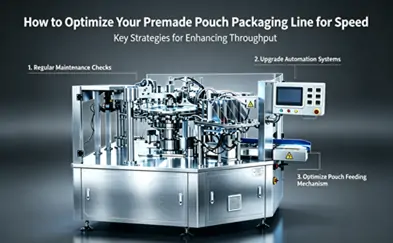
A premade pouch packaging line rated for a certain number of pouches per minute rarely delivers that figure consistently across an entire shift. The gap between the theoretical maximum and actual daily output is rarely a single bottleneck. It accumulates from brief stops at the infeed, from fill stations that wait for product, from seal bars that run a fraction of a second longer than necessary, and from changeovers that drift past the scheduled duration. Closing that gap is not about running the machine faster – it is about identifying and reducing the small losses that compound over thousands of cycles.

This article examines five areas where packaging lines lose speed and provides practical adjustments that help converters and co‑packers bring actual output closer to the machine’s capability.

1. Measure and Match the Entire Line, Not Just the Filler

A common starting point is to focus on the filling‑sealing machine itself while overlooking the equipment that feeds it and the conveyors that take pouches away. If the pouch magazine empties faster than the operator can reload it, or if the check‑weigher downstream pauses briefly between cycles, the filler will spend a portion of every hour idle – not because it is slow, but because it is waiting.

The first step in any speed‑optimisation exercise is to measure the actual cycle time of every piece of equipment around the filler. This includes the pouch‑feeding conveyor or magazine, the fill system (auger, piston, volumetric cup, or multi‑head weigher), the nitrogen flush or vacuum system if present, and the discharge conveyor. Wherever one machine runs at a different pace from the next, either the faster machine must be slowed to match, or the slower machine must be upgraded or adjusted.

If the filler is capable of 60 pouches per minute but the multi‑head weigher above it can only deliver 52 cycles, the line runs at 52. In that scenario, the filler is not the constraint – the weigher is. Resources directed at speeding up the filler would yield no additional output.

2. Reduce Infeed Hesitation

Premade pouches arrive from the supplier in a stacked condition and must be picked, opened, and placed onto the grippers. Any inconsistency in the stack – pouches that are slightly stuck together, that have a high static charge, or that vary in thickness – can cause the pick‑and‑place system to miss a cycle. A missed pouch at the infeed is a lost production opportunity that cannot be recovered later.

Several adjustments can improve infeed reliability:

  • Pouch conditioning. Allowing pouches to acclimate to the packaging room’s temperature and humidity for 24 hours before use reduces static and dimensional variation.

  • Magazine design. Some machines accept dual‑magazine feeds so that one stack can be replenished while the other is in use. If the current equipment only has a single magazine, adding a second magazine or a buffer conveyor can shorten operator reload time.

  • Air assist. A controlled puff of ionised air at the pick point can separate pouches that are clinging together and neutralise static that would otherwise make the pouch stick to the gripper.

For a rotary pouch filler with a servomotor‑driven infeed system, the infeed motion profile can often be tuned so that the pick‑and‑place arm accelerates and decelerates smoothly, reducing the incidence of dropped pouches at higher speeds.

3. Match the Fill Method to the Product

The speed of the fill station is determined by both the product’s physical properties and the filling technology. Free‑flowing granules, such as sugar or dry pet food, can be dispensed quickly through a volumetric cup or multi‑head weigher. Sticky powders, irregular solids, or products that dust heavily require slower fill cycles and sometimes additional settling time.

Where the product allows, switching from a single‑stage fill to a two‑stage or bulk‑and‑dribble fill can shorten the cycle time. The bulk fill dispenses most of the target weight at high speed, and the dribble fill tops up the remaining few grams at a lower speed to hit the target accuracy. This approach is particularly effective when the product does not fluidise well or when headroom inside the pouch is limited.

Another adjustment that sometimes yields gains is the nozzle design. A fill nozzle that is too narrow for the product creates bridging; a nozzle that is too wide can cause product to splash or dust, requiring slower actuation. Matching the nozzle diameter and shape to the product’s flow characteristics allows the fill to complete in fewer seconds per pouch.

4. Seal Time and Temperature: The Fractional Savings

Seal bars that dwell for 0.2 seconds longer than necessary cost a line 12 seconds of lost production for every 60 pouches – roughly one extra pouch that could have been produced. Over an eight‑hour shift, those fractions add up to a meaningful loss of output.

The seal temperature, pressure, and dwell time must be set for the specific pouch material, thickness, and gusset construction. A common error is to run the seal bars hotter than required on the assumption that a stronger seal is safer. In reality, excess heat can distort the pouch film, create burn‑through on thin materials, and slow the cycle because the bars must part and cool slightly before the next pouch indexes into position.

The correct seal parameters are the lowest combination of temperature, pressure, and dwell that consistently produces a hermetic seal verified by a burst test or dye‑penetration test. Once these minimum values are established, operators can lock them into the recipe and avoid manual overrides that creep upward over time.

5. Changeover: The Hidden Speed Killer

A packaging line that changes pouch sizes or product types several times per shift can lose a significant portion of its available production time to mechanical adjustments. Reducing changeover time directly increases the hours available for production – and this is often the lowest‑cost way to add capacity to an existing line.

Where possible, standardise on a common pouch width and gusset design across multiple products to reduce the need for guide‑rail and gripper adjustments. Use indexed scales or digital position indicators on adjustment points so that operators return to the same setting each time, rather than adjusting by trial and error. Quick‑release clamps and toolless fasteners on guard doors, fill nozzles, and seal bars can cut changeover time by half compared with bolt‑on components.

Some high‑speed pouch filling‑sealing lines support recipe‑based changeover, where the machine controller recalls stored positions for gripper width, fill volume, and seal parameters. This eliminates mechanical measurement and reduces the risk of misadjustment on the first few pouches after a changeover.

Maintaining Speed Gains Over Time

Gains made during a focused optimisation effort tend to erode if they are not embedded into standard operating procedures. The final step is to document the optimised settings for each product, train operators on the standard cycle, and add a daily check of the line’s actual speed against the baseline. Where deviations occur, the cause should be logged so that patterns become visible before they turn into chronic losses.

A packaging line that runs at its design speed for an entire shift is the exception rather than the norm, but lines that are systematically tuned – infeed, fill, seal, and changeover – routinely outperform those where speed is treated as a dial to be turned up. The difference is not in the machine’s maximum rating but in how small the gap is between that rating and the average speed across a production day.

For operations looking to raise output on their pouch filling equipment without sacrificing seal quality or fill accuracy, REZPACK’s high‑speed rotary pouch filling machines with servomotor infeed and dual‑bag capability are designed to reduce many of the cycle‑time losses described above. Evaluating current line data against the machine’s specifications can help quantify the potential gain before any capital commitment.

Production speed is a system property, not a machine setting. The adjustments above address the most common points where premade pouch lines lose time. Applied systematically, they can lift a line’s average output by 10% to 20% without changing the core equipment – simply by reducing the minutes and seconds that slip away in each cycle.

img

Walk the aisles of any major packaging trade fair today, and you will hear the same refrain: the next competitive edge is not just mechanical speed, but digital intelligence. The rotary premade pouch category—long defined by cam-driven precision and servo repeatability—is now absorbing a new layer of technology. Artificial intelligence is moving from a conference-room buzzword to a practical tool that changes how these lines inspect, adjust, and learn.

The shift matters because the demands on pouch packaging have never been higher. Smaller batch sizes. Thinner, more sustainable film structures that behave differently under heat. Labour shortages that make every minute of unplanned downtime hurt more than they used to. AI won't replace the mechanical engineering that makes a rotary system run at 60 or 80 cycles per minute, but it is starting to answer a question that mechanical precision alone cannot: what happens when conditions change?

Machine Vision That Learns Instead of Following Fixed Rules

Conventional vision systems on rotary fillers check for cap presence, date code legibility, and seal integrity using threshold-based algorithms. An operator sets a pass/fail boundary—say, a seal width must fall between 0.5 mm and 1.5 mm—and every pouch outside that window gets rejected. The system works, but it is brittle. A change in film opacity, ambient light, or print registration can suddenly push good pouches into the reject bin, generating waste that is invisible to the operator until someone notices the rising scrap rate.

AI-based visual inspection uses models trained on thousands of images of both acceptable and defective pouches. These models learn the natural variation that exists in a running line and can distinguish between a harmless shift in print colour and an actual seal defect. According to the VDMA (German Mechanical Engineering Industry Association), machine vision with deep learning capability can reduce false reject rates by up to 50% compared to rule-based systems in comparable inspection tasks. For a line producing 80 pouches per minute, halving false rejects translates to thousands of pouches saved per shift—each one representing material, fill product, and production time that did not need to be scrapped.

The learning capability also means the system improves over time. When an operator flags a new type of defect—a subtle crease near the zipper that traditional thresholding misses—the model can be retrained with those examples, and the entire line becomes more accurate without a mechanical adjustment. Exploring vision-guided pouch inspection systems with adaptive defect recognition can show how this capability is being integrated directly into rotary equipment.

Predictive Maintenance That Reads the Signals Before the Alarm Sounds

Rotary fillers contain dozens of moving components operating in synchrony: gripper chains, filling nozzles, sealing jaws, cooling stations. Condition monitoring has been available for years—vibration sensors, temperature probes—but the data was largely reactive. A bearing temperature exceeded a threshold, an alarm triggered, and the maintenance team scrambled.

AI shifts the approach from condition-based to genuinely predictive. By analysing the pattern of subtle changes—a gradual increase in gripper motor current draw over weeks, a slight shift in the vibration signature of a sealing jaw actuator—a trained model can estimate the remaining useful life of a component. Operators receive a maintenance recommendation during a planned changeover window rather than an alarm at 2 a.m. on a Saturday. Research published by the International Society of Automation indicates that predictive maintenance strategies can reduce unplanned downtime by 30% to 50% and lower maintenance costs by 20% to 30% compared to reactive approaches.

For a rotary filling operation, the benefit compounds. A single unexpected stop can disrupt not just the filler but the upstream pouch feeding system and downstream cartoning or case packing equipment. Keeping the rotary unit running predictably stabilises the entire packaging hall. When evaluating equipment built for data-driven maintenance, looking at rotary filling platforms with integrated condition monitoring and AI analytics provides insight into how sensor data translates to operational decisions.

Adaptive Process Control That Responds to Changing Materials

Sustainable packaging trends are pushing more converters toward mono-material films, recyclable structures, and thinner gauges. These materials are less forgiving than the multi-layer laminates they replace. A sealing jaw temperature that worked perfectly for a PET/PE laminate may over-seal a mono-PE pouch, creating wrinkles or even burn-through. Humidity swings during a summer afternoon shift can further shift the sealing window.

Traditional control systems rely on a fixed recipe: a set temperature, pressure, and dwell time stored in the machine's memory. If the result drifts out of tolerance, an operator adjusts the recipe manually. AI-based adaptive control takes a different approach. It continuously reads output variables—seal strength as inferred from jaw-closing force profiles, for example—and makes micro-adjustments to the process parameters to keep the seal within the target range even as film properties or ambient conditions change.

This capability is particularly valuable for co-packers who run different customers’ films on the same machine. Instead of dialling in each material through trial and error, the control system builds a dynamic model that adjusts sealing parameters in real time. Early adopters in food packaging have reported reductions in seal-related waste of 15% to 25% after implementing adaptive control, based on data shared at industry conferences. For operations handling multiple film types, rotary pouch filling and sealing equipment with adaptive process intelligence can illustrate how process tuning is moving from manual to automated.

Digital Twins and Virtual Commissioning for Faster Changeovers

Every format changeover on a rotary line—from a stand-up pouch with a spout to a flat pouch with a zipper—requires mechanical adjustments and a period of fine-tuning. A digital twin, which is a real-time simulation of the physical machine, allows production engineers to test the new pouch format virtually before making any physical changes. They can simulate the gripper timing, the fill nozzle trajectory, and the sealing jaw profile on a screen, identify collisions or timing conflicts, and generate the updated recipe parameters offline.

When the virtual commissioning is complete, the settings are uploaded to the physical machine, significantly compressing the changeover window. The concept has been validated in automotive and electronics manufacturing for years, and packaging machinery builders are now adopting it. The payoff is not just faster changeovers but also fewer scrapped pouches during the initial run. If your co-packing operation switches formats multiple times per week, seeking out automated rotary pouch systems with digital twin support and rapid changeover capability can help you understand how much downtime reduction is achievable.

What This Means for Your Next Equipment Decision

AI capabilities do not arrive as a standalone feature you can order from a catalogue. They come embedded in specific subsystems: the vision inspection unit, the drive and motion controller, the HMI analytics dashboard. When you evaluate new rotary packaging equipment, the conversation should go beyond strokes per minute and maximum pouch width. Ask your potential suppliers:

  • Does the vision system use deep learning models that can be retrained on my specific pouch styles?

  • Can the machine collect and export sensor data in an open format that my plant's analytics platform can ingest?

  • Is predictive maintenance limited to alarms, or does it provide an estimated time-to-failure for critical wear components?

  • How are new film types commissioned—through manual recipe tuning or through an adaptive learning cycle?

These questions reveal whether a machine is truly designed for data-driven operation or whether the term “smart” is being used loosely. The rotary pouch filling market is moving steadily toward intelligence-driven packaging. Getting clarity on these points now helps you invest in a line that will remain competitive as film materials evolve and labour availability tightens.

REZPACK, as a manufacturer focused on rotary premade pouch filling and sealing technology, continues to integrate advanced automation and control features that support this transition. Discover how REZPACK engineers rotary pouch systems for today’s intelligent packaging environments and see the specific ways modern control architectures can make your line more adaptive.

Disclaimer: The performance figures and improvement percentages cited in this article are drawn from publicly available industry research, including publications from VDMA and the International Society of Automation, as well as presentations at packaging industry technical conferences. Actual results will vary based on machine configuration, product characteristics, operating conditions, and the specific AI implementation. Readers should verify all claims with equipment suppliers and conduct their own evaluation.

img

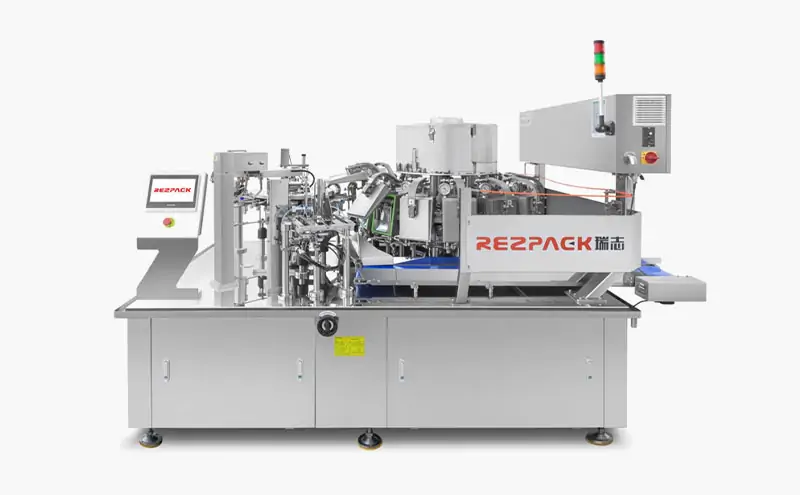
If you’ve ever watched a rotary pouch filling line in full swing, you’ll recognise the smooth, continuous motion: pouches get picked, opened, filled, sealed, and discharged in a few seconds. But when that rhythm breaks—leakers, torn gussets, or a misaligned zipper—it’s rarely obvious which station caused the failure. A clear understanding of how each station functions is your best diagnostic tool, and it’s also the first step when you need to select the right rotary premade pouch fill-seal machine for a new line or retrofit.

This guide breaks down the typical working sequence of a modern servo-driven rotary pick-fill-seal system, drawing on observations from co-packers handling everything from dusty protein powders to wet pet food. You’ll see what happens at every step, where things tend to go wrong, and which design features matter for consistent, high-integrity seals over long shifts.

rz10-gs220e-rotary-packing-machine

Station 1: Magazine Loading and Pouch Pick-Up

The process starts with a stack of flat premade pouches loaded into an inclined magazine. A servo-driven pick-and-place arm uses vacuum cups to lift the top pouch and transfer it to a pair of grippers fixed on the rotary indexing table.

Reliable singulation is the hidden challenge here. Static buildup, matte-finish tackiness, or simply the weight of a full stack can cause two pouches to stick together. More advanced systems counter this with an adjustable air knife that injects a jet of air between the top pouches during pickup, combined with a vacuum surge protection algorithm that prevents the cups from pulling a double layer. If you’re running thin, high-slip recyclable films, you may also need a mechanical separation finger that pre-opens the pouch edge before the vacuum engages. Machines that offer this level of pick control significantly reduce miss-picks when film properties vary from batch to batch, and you can explore a configuration built around servo-driven, multi-assist bag separation to see how these features integrate.

Station 2: Bag Opening and Zipper Engagement

Once clamped, the pouch indexes to the opening station. A combination of blown air and opposing vacuum suction plates pulls the pouch faces apart. If the pouch has a press-to-close zipper or slider, a dedicated mechanism engages the zipper profile at this stage to make sure it’s fully separated. Without this step, the product can lodge in the zipper track and compromise the top seal later.

Also critical here is bottom support. Stand-up pouches and quad-seal bags need a bottom forming plate or a gentle mechanical push from below to unfold completely. A machine with an adjustable bottom support that handles different pouch heights without tools saves time and avoids underfilled, unstable packs.

Station 3: Product Filling and Dust Containment

The open pouch moves to the filling station, where an auger filler, volumetric cup, or multi-head weigher deposits the product through a descending funnel. For dusty products—protein powder, spices, fine chemicals—the area around this station must be physically isolated from the sealing stations further down the line.

When product dust drifts onto heated sealing jaws, it carbonises and creates weak, porous seals. Effective designs use a partitioned working zone with a dedicated vacuum extraction port right at the fill point. One spice co-packer retrofitted such a dust hood onto their line and reduced seal contamination by over 70%, without dropping line speed. If you pack fine powders, this is not an optional add-on; it’s a requirement for consistent hermetic seals.

Station 4 & 5: Multi-Stage Heat Sealing and Active Cooling

After filling, the pouch enters the heat-seal station. Heated jaws close on the pouch top, applying controlled temperature, pressure, and dwell time to fuse the inner polymer layers. For demanding films—thin all-PE recyclable structures, for instance—a single heating pulse often isn’t enough. A dual-pulse profile, where a first stage pre-softens the sealant layer and a second stage completes the bond, produces much more uniform seals and avoids pinholes.

Right after heat sealing, a dedicated cooling station locks the seal while it solidifies. Some machines skip this to reduce footprint, but without active cooling, the warm seal can pull apart when grippers release, especially with heavy product. If you’ve noticed leak rates creeping up during summer months, a missing cooling jaw set is often the root cause. A system that includes independent seal cooling jaws with extended dwell offers a clear reliability advantage; you can view a layout that integrates exactly this multi-stage sealing and cooling approach to see how it fits within the rotary sequence.

Station 6: Gas Flushing and Zipper Closure

For modified-atmosphere packaging, a gas-flushing nozzle injects nitrogen or CO₂ before the final top seal. Rotary machines with 8 or 10 stations can dedicate an entire station to gas dwell, which allows thorough oxygen displacement without over-pressurising the pouch. Immediately afterwards, a mechanical zipper-closing station presses the zipper track closed while the pouch is still firmly held, ensuring it’s parallel to the top seal.

Station 7: Discharge and Inline Quality Check

The finished pouch is released from the grippers and falls onto a take-away conveyor, passing under a checkweigher and metal detector. An automatic reject station pushes any out-of-spec package off the line. In well-designed systems, a soft pneumatic arm handles rejection rather than a high-speed blast, avoiding damage to heavy or fragile pouch edges.

Common Pitfalls When Interpreting Speed and Changeover Claims

A common trap is to compare machines by their maximum rated speed. Real sustained output depends on how the pick-and-place system handles film variability over an 8-hour shift, not on a 15-minute demo run. Servo-driven pick arms with real-time vacuum monitoring maintain pickup consistency as the stack height changes, while purely mechanical cam systems often need frequent adjustment.

Changeover time is equally important. If switching from a 100 mm to a 150 mm pouch requires swapping eight gripper sets and three seal jaws, you’ll lose hours of production every month. Tool-free, quick-release change parts and a recipe-driven HMI that recalls all servo positions, temperatures, and vacuum timers transform what could be a 45-minute changeover into a 10-minute task. When you’re evaluating equipment, ask for documented changeover logs, not just a spec-sheet promise. A system built around tool-free, recipe-driven changeovers is worth a close look if you run multiple pouch formats per week.

Turning Process Knowledge into a Reliable Production Decision

Understanding each station—pickup, opening, filling, sealing, cooling—gives you a real diagnostic framework you can use on your current line. When you translate that knowledge into a machine evaluation, focus on running your own film and product in a trial, provide the film’s coefficient of friction and the product’s bulk density, and ask for shift-long performance data, not just demo video highlights.

That applied understanding is ultimately what defines the right rotary premade pouch fill seal machine for your operation. If you’d like to move from principles to specifications, REZPACK’s engineering team can arrange a focused application review based on your pouch materials and production targets.

img

Picture this: you’ve just landed a major contract to pack granola into stand-up pouches with a tamper-evident zipper. Your current machine is either too slow, too manual, or tears the delicate matte film on every third cycle. You start searching for a “rotary premade pouch fill seal machine,” and within an hour, you’re drowning in spec sheets—some boasting 40 bags per minute, others 120. But faster isn’t always better, and a low sticker price can hide massive downtime costs.

This guide is built from real conversations with contract packagers and food manufacturers. It’s not about pushing a single spec; it’s about understanding the trade-offs so you can choose a machine that fits your pouch materials, product type, and production floor reality. We’ll touch on what actually matters: bag gripping technology, changeover logic, and hidden automation features—and by the end, you’ll have a clear checklist to bring to any supplier conversation.

RZ8-S120 high speed automatic double bag filling and sealing machine for packaging

Bag Range vs. Real-World Flexibility

Most spec sheets list a “bag width range.” What they often omit is how many physical change parts you need—and how much time it takes to swap them. A machine might technically handle a 100 mm to 200 mm wide pouch, but if you need to replace grippers, guide rails, and sealing jaws every time you shift from a small coffee pouch to a large detergent refill, your OEE will suffer.

Ask suppliers these three questions:

  • Can I run a flat-bottom pouch and a stand-up pouch on the same set of grippers?

  • How many quick-release change parts are involved for a full-width transition?

  • What’s the average tool-free adjustment time recorded from actual customer sites?

One area often overlooked is the interaction between the bag opener and the product fill zone. For dusty products like protein powder or fine spices, a poorly sealed fill zone leads to product buildup on sealing jaws, causing leaks. Look for systems that offer a physical separation between the fill station and the sealing station, ideally with a positive dust extraction port. This isn’t a luxury in food packing; it’s a necessity for consistent hermetic seals.

The Speed Trap: Why “Maximum Speed” Is a Vanity Metric

A machine that runs 100 bags per minute with a pristine, rigid pouch can drop to 40 bpm when you introduce a thin, glossy recycled film that clings to the opening guides. True speed depends on the bag placer technology. Rotary machines with servo-driven, dual-pick vacuum grippers can compensate for film variability far better than mechanical cam-driven placers. They can also gently pick up a bag with a vacuum surge protection logic that prevents double-bagging without crushing the pouch.

What’s even more telling is the sustained speed over a 7-hour shift, including operator breaks and film splices. One co-packer we interviewed reduced their average speed from a claimed 80 bpm to a real 52 bpm once they accounted for splice stops and zipper verification jams. That 35% drop is where your margin erodes. When evaluating a machine, request a data log from a similar application showing bags-per-minute over an entire shift, not just a 20-minute demo video.

Automation Level: From Manual Loading to “Lights-Out” Capability

Here’s a framework to map your needs:

Automation Tier Description Best For
Semi-Automatic The operator manually places each bag onto a loading station; the machine fills and seals. Startups, short runs, frequent product changes
Automatic Pick & Place The machine picks bags from a magazine, opens, fills, and seals them. Dedicated lines, runs of 5,000+ pouches per day
Integrated Quality Control Includes checkweigher feedback, no-bag-no-fill sensors, seal integrity inspection, and automatic reject station. Food safety compliance, retail-ready packaging
Full-Line Integration Robot case packing, serialisation, and remote diagnostics are built into the control system. 24/7 high-volume operations seeking traceability

For many mid-tier food brands, the sweet spot is an automatic pick-and-place machine with an integrated checkweigher and a seal cooling zone. The cooling zone is critical: without it, still-warm seals can open under product weight as pouches drop into a collection bin, especially with heavy products like wet pet food. If you’ve ever faced mysterious leaks only during the summer months, a missing or undersized cooling section was often the culprit. You can explore an example of a high-speed configuration that includes independent seal cooling to see how this is implemented mechanically.

Material Compatibility: Why Your Laminates Are the True Test

The vast majority of seal defects trace back to a mismatch between the machine’s heat-sealing profile and the film’s structure. A machine optimised for PE/PE recyclable films requires precise, dual-pulse heat control because PE has a narrow sealing window—too hot and it puckers, too cold and it peels. On the other hand, a PET/Alu/PE laminate is more forgiving.

Before you buy, run a material trial with your actual film rolls—not the supplier’s perfectly conditioned sample pouch. Provide the machine builder with the COF (coefficient of friction) data of your film’s outer layer; this determines whether the bag magazine can separate the top pouch reliably. If the COF is too high (tacky matte finish) or too low (high-slip glossy), you may need an auxiliary bag separation system. Get specific guidance on material handling options that include adjustable vacuum and air-knife assist for tricky films.

A Word on Sustainability: Running Recyclable Monomaterial Pouches

The shift to mono-PP or mono-PE pouches is accelerating due to retailer mandates and EPR fees. These materials, however, are less stiff and more heat-sensitive. A machine with 8 or 10 stations allows you to add a long-dwell-time sealing station, which is practically mandatory for high-integrity mono-PE seals. The extra station also lets you insert a nitrogen flush or gas-flushing dwell after the initial fill, which is crucial for extending shelf life in flexible packaging without a rigid can.

In a recent retrofit project for a snack brand transitioning to mono-PP, the ability to individually adjust seal jaw temperature and pressure across four sequential stations was the deciding factor. Machines with only a single sealing station couldn’t achieve the required 90 kPa burst strength consistently. When you’re planning a line for recyclable pouches, prioritise station count and independent jaw control over nominal speed.

Washdown and Maintenance: What the Stainless Steel Exterior Hides

Food facilities need washdown capability, but “full stainless steel” often applies only to the frame and cover panels. The real maintenance headache lives in the rotary indexing mechanism and the cam followers. Look for an automatic centralised lubrication system that feeds multiple grease points without opening the guard door. If the machine uses oil-impregnated bronze bushings in the bag placer arms, confirm the replacement interval and whether it’s a field-serviceable task or requires a service visit.

Wiring matters, too. In wet environments, cables inside the electrical cabinet should have IP65-rated connectors, not just cable glands. This prevents water ingress when the machine is foamed during sanitation shifts. If you have multiple product changeovers daily, a recipe-driven control system that recalls all servo positions, temperatures, and vacuum timers from a single HMI screen isn’t a convenience—it’s a huge reduction in setup errors.

Getting Your Selection Right: A Decision Roadmap

By now, you realise that a “right rotary premade pouch fill seal machine” is the one that handles your specific film, product, and throughput with minimal hidden labour. The core of a good decision comes down to running your product on the machine, with your bags, and asking for shift-long data logs, not just demo videos. If you want to see how a machine that ticks these boxes handles in a production setting, review the detailed specifications of one such system and compare it against your checklist. For a smoother evaluation process, you can also request an application-specific trial directly from REZPACK’s engineering team.

GET A QUOTE

+86 18989886089

GET IN TOUCH NOW
Captcha Code
×
We value your privacy
We use cookies to provide you with a better online experience, analyse and measure website usage, and assist in our marketing efforts.
Accept All