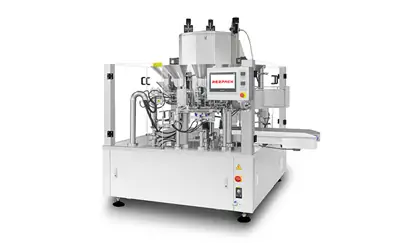
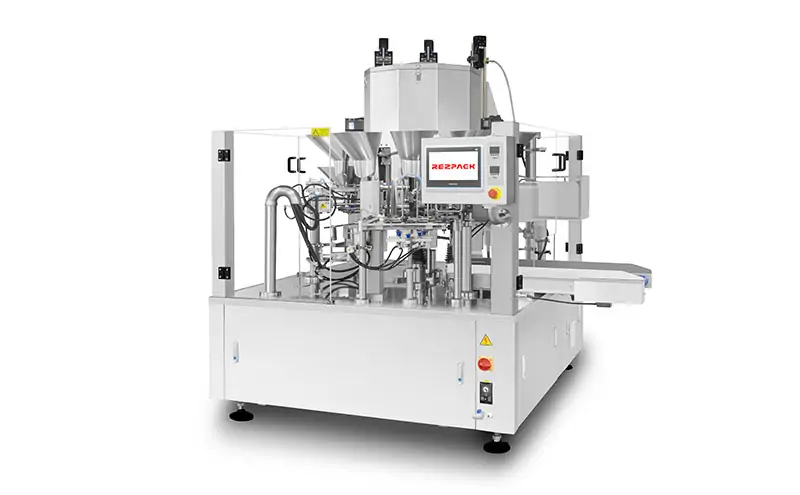
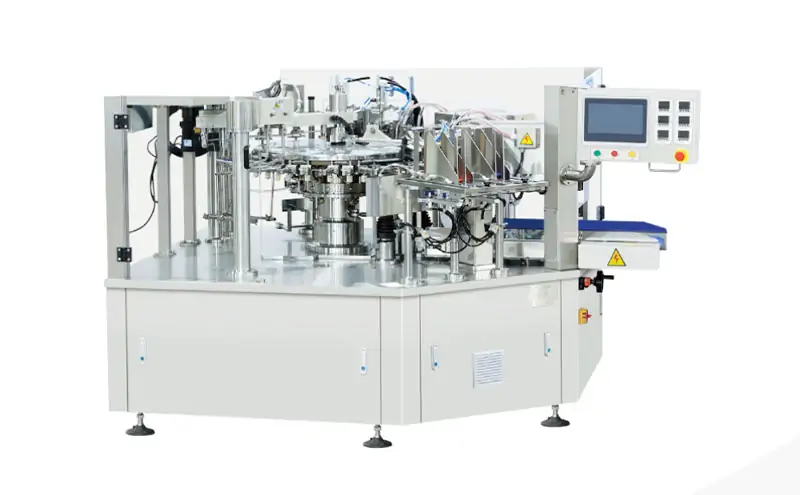
The Four Cups Fill Seal machine is a high-performance packaging solution designed for high-volume production of dairy products, sauces, soups, and other viscous liquids. This machine offers exceptional efficiency, speed, and accuracy, making it the perfect choice for businesses looking to streamline their packaging process.

Key Features

1.Simultaneous Multi-Cup Filling

With four filling heads, the machine can fill four cups at once, significantly increasing production speed and reducing cycle time.

2.Versatile Cup Compatibility

Suitable for various cup sizes and materials, including PP, PS, PET, and paper cups, accommodating a wide range of product types.

3.High Precision Sealing

The precision sealing system ensures a secure, leak-proof seal for each cup, preserving product freshness and quality.

4.Advanced Control System

The PLC and touch screen allow for intuitive operation and real-time monitoring, making it easy to adjust filling speed, volume, and sealing time.

5.Hygienic Design

Built with 304 stainless steel, the machine meets food safety standards and is easy to clean, ensuring high hygiene in food production.

6.High-Speed Performance

Capable of packaging up to 6,000 cups per hour, this machine maximizes productivity without compromising on quality.

Applications

Ideal for packaging a variety of products, including:

Dairy Products: Yogurt, cream, sour cream.

Sauces & Condiments: Ketchup, mayonnaise, salad dressings.

Soups & Gravies: Ready-to-eat soups, gravies.

Other Viscous Liquids: Honey, jam, and more.

Why Choose the Four Cups Fill Seal Machine?

Speed & Efficiency: Multi-cup filling for faster packaging.

Precision: Consistent filling and sealing for a perfect product every time.

Flexibility: Supports different cup sizes and materials.

Easy Operation: User-friendly control system for smooth operation.

High Hygiene Standards: Stainless steel construction for easy cleaning.

The Four Cups Fill Seal machine is the ideal solution for businesses looking to increase efficiency, speed, and product consistency in their packaging lines. Whether you're packaging yogurt, sauces, or soups, this machine provides the reliability and flexibility you need to meet growing demand.

Inquire Now
Recent Post
img

 Trump’s 17 Companies Are Racing to China

“Apple, Tesla, Nvidia, Boeing, Qualcomm… Why are these 17 CEOs flying to China right now?”

On May 13, Air Force One landed in Beijing. With it came 17 top executives – Tim Cook, Elon Musk, Jensen Huang, Kelly Ortberg, Cristiano Amon, and more. Their trip made global headlines – not for politics, but for business.

They came to lock in Chinese manufacturing.

  • Apple – over 70% of its key suppliers are still based in China.

  • Tesla – its Shanghai Gigafactory accounts for half of global output.

  • Qualcomm – more than 50% of revenue comes from China.

  • Nvidia – its chips rely on Chinese supply chains and rare earths.

After tariffs, export controls, and “decoupling” talk, these giants are voting with their feet. They know something Washington is slow to admit: China’s manufacturing edge is irreplaceable.

So what are they chasing? Speed. Quality. Smart integration. And here’s how Unionpack, a leading Chinese packaging machinery manufacturer, delivers all three.


Secret #1: Speed – Turning Time Into a Competitive Advantage

Tesla-Shanghai-Gigafactory

When Tesla broke ground on its Shanghai Gigafactory, it took less than 10 months to start production. Traditional automakers need 3–5 years.

For your business – whether food, beverage, or consumer goods – every day counts. A packaging line that runs one week earlier means you can capture a peak season, fill a rush order, or beat a competitor to market.

Unionpack understands speed. With over 30 years of experience, we keep critical spare parts in stock and follow a lean production system. Standard machines ship in just 45 days after drawing approval. And our on-time delivery rate consistently beats industry averages.

Speed isn’t just a promise – it’s built into our process.

 Demonstrate-the-fast-production-rhythm-of-Unionpack


Secret #2: Quality – Why Global Brands Trust China

China’s manufacturing rise wasn’t built on cheap labor alone. It was forged by relentless quality improvement. Apple’s legendary push for 99%+ yield rates turned China’s electronics supply chain into a global benchmark in precision machining, laser welding, and automated assembly.

ISO-CE-Certification-Certificate-of-Unionpack

The same quality culture drives Unionpack.

  • ISO & CE certified across all product lines.

  • Over 3,000 enterprise customers worldwide, including Nestlé, Hershey, Kao, and Ovaltine.

  • Exported to 40+ countries – from Southeast Asia to Europe and the Americas.

We don’t just build machines. We build consistency. Every rotary pouch packer, every vacuum sealer, every cartoner undergoes strict in-process and final inspections. That’s why global brands come back to us – year after year.

Quality isn’t a slogan. It’s the reason we’ve served 3,000+ clients.

Customer-Logo-Wall 


Secret #3: Smart & Integrated – Total Automation Solutions

Today’s manufacturing competition is no longer about single machines. It’s about full-line efficiency. The 17 CEOs aren’t just chasing cheap parts – they want integrated, intelligent solutions that reduce labor, cut downtime, and boost throughput.

Unionpack delivers exactly that. Our product portfolio covers almost every packaging scenario:

Machine Type Key Features Speed
Rotary Premade Pouch Fill & Seal Bag width 55–400mm, multi-model Up to 100 bags/min
Rotary Vacuum Packaging For meat, seafood, ready meals Up to 120 bags/min
Horizontal Flow Wrapper (HFFS) Candy, biscuits, snacks Up to 1,600 pcs/min
Thermoforming Machine Gas flushing, skin packing Max film width 520mm
Cartoning Machine Gluing or tucking, horizontal/vertical feed Up to 120 boxes/min
Multi-head Weigher & Conveyors Auger, Z-type, bucket, vacuum conveyors High-accuracy weighing

But we don’t just sell machines. We design complete packaging lines – from cup filling and cartoning to palletizing. One integrated system. One point of contact. Zero compatibility headaches.

From a single pouch packer to a fully automatic line – Unionpack makes it work.

Automatic Packaging Whole Line 


Why Choose Unionpack? The China Advantage, Delivered

Trump’s 17 companies are fighting for a piece of China’s manufacturing ecosystem. But you don’t have to be a Fortune 500 giant to benefit.

Unionpack brings the same speed, quality, and intelligence to businesses of all sizes.

  • ✅ 30+ years in packaging machinery

  • ✅ 40+ countries served

  • ✅ 3,000+ clients worldwide

  • ✅ Trusted by Nestlé, Hershey, Kao

  • ✅ 24/7 online support & free technician training

  • ✅ Spare parts readily available

Ready to Upgrade Your Packaging Line?

Stop waiting months for machines. Stop compromising on quality. Stop piecing together incompatible equipment.

Contact Unionpack today for a free consultation and a customized automation solution.

Visit our website: https://www.rezpack.com/
WhatsApp (24/7): +86 18989886089
Email: info@rezpack.com

Let’s build your packaging future – faster, smarter, and more reliable.


*(Based on the real-world context of the May 2026 U.S. CEO delegation to China. News references: Sohu, NetEase, Lianhe Zaobao, POLITICO.)*

img

The packaging floor in 2026 looks nothing like it did five years ago. Rising labor costs, tighter sustainability regulations, and unpredictable material supply chains have pushed operators to seek smarter, more reliable automation. But with so many “smart” promises, where should you focus your next investment?

In this article, we break down five real‑world automation trends that are already delivering measurable ROI for medium and large packaging lines. No buzzwords—just practical insights backed by industry data and on‑floor experience.

automated packaging line with collaborative robots and real-time monitoring displays

Trend 1: AI‑Driven Predictive Maintenance Replaces Scheduled Servicing

For years, packaging plants followed fixed maintenance calendars—replace a seal every 2,000 hours, lubricate bearings each month. That approach wastes labor and often misses early failures. By 2026, over 60% of new automated packaging machinery will include built‑in AI models that learn normal vibration, temperature, and current draw patterns.

Take a recent case from a Midwest dairy producer: after retrofitting their existing line with vibration sensors and an edge AI unit, they cut unplanned downtime by 73% in six months. The system flagged a degrading bearing 11 days before failure, allowing them to schedule repair during a planned changeover. For production managers, this means you can stop guessing and start trusting real‑time health scores.

If you are evaluating automated packaging machinery for high‑volume lines, look for systems that provide raw sensor data access, not just a red/green light. Open protocols let you integrate with your existing SCADA or CMMS.

Trend 2: Sustainable Material Handling Without Slowing Down

The shift to mono‑material films, recycled content, and compostable substrates has created a headache for packaging engineers: these materials behave differently. They stretch more, seal at narrower temperature windows, and generate more static. Many operators feared that going green meant cutting line speed by 20% or more.

New automation solves this through adaptive tension control and real‑time temperature profiling. Advanced servo drives can adjust film feed force hundreds of times per second, compensating for variations in recycled PET or bio‑based PLA. A European snack brand switched to 30% PCR film on their vertical form‑fill‑seal lines—and maintained 98% of their original throughput after upgrading to adaptive drives.

Bottom line: You don’t have to choose between sustainability and productivity. The right integrated vacuum sealing technology automatically adapts to challenging materials, keeping your OEE high while reducing plastic waste.

Trend 3: Collaborative Robots Take Over Case Packing and Palletizing

Industrial robots have been around for decades, but they require safety cages, dedicated programmers, and large footprints. Collaborative robots change that. By 2026, cobots will handle over 40% of secondary packaging tasks—case packing, tray loading, and even bag top‑sealing assistance.

What makes them different? Built‑in torque sensors and vision guidance let a cobot work safely next to a human operator without fencing. Setup time drops from weeks to hours. For example, a small coffee roaster installed a single cobot arm to place valve bags into shipping cartons; the same arm now also helps with palletizing during peak shifts. Payback was under eight months.

A practical tip: When adding cobots, make sure your upstream equipment—such as your energy‑smart rotary systems—can communicate the exact product position and cycle timing. Otherwise, you’ll create a bottleneck at the transfer point.

Trend 4: Digital Twins for Packaging Line Simulation and Remote Optimization

Before cutting a single metal part for a new line, leading brands now build a digital twin—a virtual replica that simulates every sensor, motor, and conveyor. The technology has matured to the point where accuracy reaches 98–99% compared to physical commissioning.

Why does this matter for 2026? Because digital twins allow you to test “what if” scenarios without stopping production. Want to see if adding a second vacuum chamber will increase throughput by 15%? Run the simulation. Need to troubleshoot a recurring misfeed that only happens at 2 AM? Replay the event in the digital twin.

Early adopters report 50% shorter ramp‑up times for new product introductions and a 30% reduction in changeover errors. Some equipment providers now include a basic digital twin with every major machine—though the real value comes from integrating twins across all your line assets.

digital twin simulation of a high-speed packaging line

Trend 5: Energy‑Efficient Vacuum Sealing Cuts Carbon and Costs

Vacuum sealing is essential for extending shelf life in food, medical, and electronic component packaging. But traditional vacuum pumps are energy hogs—often consuming as much power as the rest of the line combined. Newer designs use variable‑speed drives, oil‑free rotary claws, and intelligent cycle optimization.

Field data from a large meat processor shows that after replacing their constant‑speed vacuum pump with a demand‑controlled system, they saved 41% of sealing energy and reduced heat output into the plant, lowering air conditioning loads. The payback period was 14 months at $0.12/kWh.

For operations running 24/7, even a 10% improvement in vacuum efficiency can add tens of thousands of dollars annually to the bottom line. When you review your next equipment upgrade, ask for specific energy consumption figures per thousand cycles—not just peak power ratings.

How to Get These Trends Working on Your Floor Tomorrow

Trends are useful, but execution matters. The five shifts above are not futuristic—they are already deployed in competitive packaging lines across North America and Europe. The challenge is finding equipment that integrates these capabilities without forcing you to replace your whole line at once.

That’s where modular, upgrade‑ready designs come in. Instead of locking you into a rigid “all or nothing” platform, some manufacturers build their machines with separate control modules for predictive diagnostics, material adaptation, and energy efficiency. You can start with the trend that hurts most—say, material waste—and add others later.

If you want to see how these automation principles apply to your specific products (wet or dry foods, pet food, chemical powders, or medical devices), it’s worth looking at a platform designed for real‑world flexibility. You can explore professional‑grade packaging equipment built around serviceability and low total cost of ownership.


Final thought: The best automation doesn’t demand that you become a data scientist or a robot programmer. It works quietly, adapts to your materials, and tells you exactly what needs attention—so you can focus on running a profitable, reliable packaging operation.

img

You’ve seen them a thousand times. Stand-up pouches with zippers on supermarket shelves. Flat pouches of coffee with one-way valves. Doypacks of baby food. What you probably haven’t seen is the machine that fills and seals them—because a good packaging line runs quietly in the background.

For many small and mid-sized businesses, moving from hand-filling to automated pouch packaging feels like a leap. The terminology alone can be intimidating. Pick fill seal. Rotary indexer. Intermittent motion. Vacuum gas flush.

This guide breaks down exactly what a premade pouch packaging machine does, how it works, and what you need to know before buying one.

A variety of stand-up pouches and flat pouches on a white background

What Does a Premade Pouch Packaging Machine Do?

Simply put, this type of equipment takes pre-manufactured bags (pouches) that already have their bottom and side seals, opens them, fills them with product, and seals the top—all automatically.

The term “premade” distinguishes these machines from form-fill-seal systems, which create bags from a roll of flat film. Premade pouch machines are more flexible with bag styles (stand-up, flat, zipper, spout) and materials (foil, clear film, kraft paper laminate).

A complete cycle typically includes:

  1. Pick – A suction cup or gripper pulls a single pouch from a magazine

  2. Open–air jets or mechanical fingers open the pouch mouth

  3. Fill – Product drops through a funnel or multi-head weigher

  4. Seal – Heat sealing bars close the top, sometimes after vacuum or gas flush

Key Components of a Pouch Packing Line

Before diving into machine types, it helps to understand the main parts that work together.

Component Function
Pouch magazine Holds a stack of premade pouches and feeds one at a time
Pick-and-place arm Transfers pouches to the carousel or indexing conveyor
Opening station Uses suction or mechanical fingers to open the pouch mouth
Filler interface Connects to an auger, cup filler, or weigher
Seal station Applies heat and pressure to seal the top of the pouch
Discharge conveyor Moves finished pouches to downstream checkweighers or packers

Rotary vs Linear: The Two Main Designs

Premade pouch machines come in two primary configurations: linear and rotary. The difference matters for speed, footprint, and changeover time.

Linear machines move pouches forward on a straight path, stopping at each station. This design is simpler, often less expensive, and works well for speeds up to 50 pouches per minute. Changeovers are usually faster because adjustments are straightforward.

Rotary machines mount pouches on a rotating carousel. The wheel turns continuously, so pouches never stop moving. This enables speeds from 60 to over 120 pouches per minute. Rotary designs also provide more consistent vacuum and sealing because the pouch stays clamped throughout the cycle.

For a deeper comparison of these two designs on real production floors, explore this side-by-side analysis of linear vs rotary performance.

How a Typical Cycle Works (Step by Step)

Let’s walk through a complete cycle on a mid-speed rotary platform. Even if you’re considering a linear machine, the basic steps are similar.

Step 1: Pouch feeding. A stack of pouches sits in a magazine. A suction cup pulls the front pouch forward while air jets prevent double picks. The pouch is transferred to a clamp on the carousel.

Step 2: Pouch opening. As the carousel rotates, the pouch passes under an opening station. Two suction cups pull the front and back panels apart. Sensors confirm the pouch is fully open before the product drops.

Step 3: Filling. The open pouch moves under a filler discharge. Product falls in—everything from coffee beans to pet treats to liquid soap. Some systems use a vibratory fill to settle product and reduce air pockets.

Step 4: Pre-seal (optional). For dusty or fine products, a pre-seal tacks the top edges together to prevent contamination of the final seal area.

Step 5: Vacuum or gas flush (optional). For extended shelf life, the machine can remove oxygen and replace it with nitrogen before sealing. This is common for coffee, nuts, and dried meat.

Step 6: Final sealing. Heated bars press the top of the pouch for a specific dwell time. Temperature and pressure are carefully controlled. A cooling bar may follow to set the seal.

Step 7: Discharge. The finished pouch is released onto a conveyor. Rejected pouches (if a sensor detects an issue) are diverted to a separate chute.

The entire process, from pick to discharge, typically takes 1 to 3 seconds per pouch on a rotary system.

What Products Work Best?

Premade pouch machines handle an incredibly wide range of products:

  • Granular: coffee beans, rice, nuts, seeds, pet food

  • Powder: protein powder, flour, spice blends, infant formula

  • Liquid: sauces, oils, ready-to-drink beverages

  • Solid pieces: candy, dried fruit, frozen vegetables, hardware

The key requirement is that the product must flow predictably through a filler. Sticky, stringy, or oversized items may need specialized fillers.

Common Misconceptions

Myth: “Premade pouches cost more than rollstock film.”
Fact: While the pouch itself costs slightly more, the machine is simpler, and changeover is faster. For short to medium runs with multiple SKUs, premade often wins on total cost.

Myth: “You need highly trained operators.”
Fact: Modern machines with touchscreen controls and recipe storage reduce training to hours, not weeks. One contract packer reported training new operators in under two hours.

Myth: “Rotary machines are only for huge factories.”
Fact: Compact rotary designs now fit in small footprints. A 120-pouch-per-minute rotary line often occupies less floor space than a 50-pouch-per-minute linear line.

Choosing the Right Machine for Your Volume

A rotary premade pouch pick fill seal machine makes sense when you need sustained speeds above 55 pouches per minute, especially with vacuum or gas flush. The continuous motion delivers consistent seal quality even at high output.

Linear machines still dominate for slower lines, frequent changeovers, or tight capital budgets. Many small roasters and bakeries start with a linear machine and upgrade to rotary as they grow.

To see real-world examples of which businesses choose rotary versus linear, browse application case studies from food and non-food packers.

Small footprint rotary machine

Maintenance and Long-Term Costs

Every pouch machine needs regular attention. The most common wear items are:

  • Suction cups (replace every 3-6 months)

  • Sealing bands and Teflon tape (monthly inspection)

  • Heating elements (6-12 months depending on usage)

The difference between good and great machines is tool-less access. If you need a wrench to change a suction cup or a sealing band, downtime adds up. Machines with quick-release components and accessible guarding significantly reduce maintenance time.

Is a Premade Pouch Machine Right for You?

Ask yourself three questions:

  1. Do you use stand-up pouches, flat pouches, or bags with zippers/spouts? If yes, premade machines are your best option.

  2. Is your current hand-filling or semi-auto line costing you labor hours? Automation typically pays back within 12-18 months for lines running 30+ pouches per minute.

  3. Will your volume grow beyond 50 pouches per minute? If yes, consider rotary from the start to avoid upgrading twice.

Next Steps

Understanding what a premade pouch packaging machine does is the first step. The second step is matching the right configuration—rotary vs linear, vacuum vs standard seal, servo-driven vs pneumatic—to your actual product and shift schedule.

If you’re ready to move beyond the basics and evaluate specific models for your product type, review detailed specifications, and request a product matching consultation.

Have you already narrowed down your speed requirements, or are you still exploring options? Knowing your target output per minute makes the next conversation much more productive.

img

The production manager’s voice was tense. “Our upstream filler runs at 100 units per minute, but our bagging line maxes out at 45. We’re building inventory all day and shipping nothing.”

That phone call happens every week. A packaging line that can’t keep up with the rest of the factory creates a costly bottleneck. Adding a second shift helps, but that doubles labor cost. Adding a second machine doubles floor space and maintenance.

The real solution lies in understanding why intermittent motion machines hit a speed wall—and what continuous motion technology does differently.

Why Most Pouch Lines Stall Below 60 Bags/Min

Conventional pick-fill-seal machines use stop-and-go indexing. The pouch moves to a station, stops, the operation happens, and then it moves again. This works perfectly at 30–50 cycles per minute. But above 55, physics intervenes.

Every stop creates inertia. Pouches tip over. Films stretch. Sealing bars must dwell longer than the machine allows. The result: misfeeds, wrinkled seals, and constant operator intervention.

According to data from packaging equipment audits, nearly 70% of intermittent-motion lines running above 50 BPM experience at least one jam per hour. That doesn’t show up on the spec sheet.

The Continuous Motion Difference

Instead of stopping for each operation, a continuous rotary platform keeps pouches moving through a carousel. Pick, open, fill, and seal happen while the pouch travels in a smooth circular path.

The benefits multiply at higher speeds:

  • No start-stop shock means pouches stay upright

  • Sealing bars rotate with the pouch, providing consistent dwell time regardless of speed

  • Vacuum and gas flush cycles happen during travel, not after stopping

One pet treat manufacturer documented the switch: their old linear line averaged 48 bags per minute with 12% rejects. After moving to a continuous rotary design, they sustained 112 bags per minute with under 2% rejects. The same operators ran both lines.

Three Bottlenecks That Kill Throughput (And How to Fix Them)

Even with the right machine type, speed killers hide in plain sight. Here are the most common ones we’ve seen across dozens of packaging floors.

Bottleneck 1: Film Slippage and Misregistration

At high speeds, film tension becomes critical. If the machine uses friction alone to advance the web, slippage causes off-registration prints and uneven seals.

Fix: Look for servo-driven film pull systems with closed-loop tension control. These adjust in real time, maintaining perfect registration even during acceleration and deceleration. Some advanced systems store tension profiles for different film types—nylon, polyester, or laminate.

Bottleneck 2: Slow Changeovers

A machine that runs 120 BPM for one hour, then takes 45 minutes to switch pouch size,s delivers an effective speed far below its rating. Changeover time is the hidden thief of overall equipment effectiveness (OEE).

Fix: Prioritize machines with recipe storage and motorized adjustments. Modern rotary platforms can store 50+ pouch recipes and complete size changes in under 10 minutes. One cheese packaging plant reduced its daily changeover time from 2.5 hours to 35 minutes by adopting this feature.

High Speed Double Bag Filling Sealing Machine

Bottleneck 3: Operator Intervention During Jams

Every jam stops production. But the real cost is how long it takes to clear. Machines with difficult access—guards that require tools, sealing areas buried behind panels—turn 30-second jams into 10-minute stoppages.

Fix: Evaluate tool-less access. Can the operator open the guarding with one motion? Are sealing bars visible and reachable without disassembly? According to maintenance logs, machines with full tool-less access reduce jam clearance time by an average of 70%.

The Speed Formula: What 120 BPM Really Requires

Reaching 120 bags per minute isn’t just about the machine. It requires coordination across four components:

Component Requirement for 120 BPM
Pouch infeed Continuous magazine with automatic splicing
Filler integration Volumetric or multi-head weigher that discharges within 0.5 seconds
Vacuum system High-flow pump capable of 99% evacuation in <1.5 seconds
Sealing system Constant temperature control with 0.5°C accuracy

Missing any of these creates a new bottleneck elsewhere. A rotary premade pouch pick fill seal machine running at 120 BPM demands that every upstream and downstream element is synchronized.

For a detailed breakdown of how to match filler speed and vacuum capacity to target output, [refer to this speed-matching technical reference].

Real-World Results: From 55 to 115 BPM

A frozen vegetable packer approached us with a familiar problem. Their existing line topped out at 55 BPM because the linear indexing machine couldn’t handle the weight of 2-pound frozen bags. Bags toppled during stops, and the operator spent half the shift picking up fallen pouches.

After evaluating continuous rotary designs, they installed a system with servo-driven pick-and-place and a 10-station carousel. The results after 90 days:

  • Sustained output: 115 BPM (averaged over full shifts)

  • Reject rate: 1.7% (down from 9.2%)

  • Operator fatigue complaints: nearly eliminated

The payback period? Eleven months, based on labor savings and reduced film waste alone.

To calculate your own potential payback at different speed targets, [download this ROI calculation worksheet].

Common Misconceptions About High-Speed Packaging

Myth: “Faster machines require more skilled operators.”
Fact: Modern rotary platforms with intuitive touchscreens often require less training because they automate tension, timing, and registration. One bakery chain reduced training time from 40 hours to 8 hours after switching.

Myth: “High speed means higher film waste.”
Fact: Continuous motion actually reduces waste because there’s no start-stop film snapping. Many users report 15-25% less film waste at 100+ BPM compared to intermittent lines at 50 BPM.

Myth: “You need a new facility to run Rotary.”
Fact: Rotary machines have a much smaller footprint per output than linear designs. A 120 BPM rotary system often occupies less floor space than a 50 BPM linear system.

Your Path to 120 Bags Per Minute

Before investing in any high-speed solution, follow this three-step validation process:

  1. Calculate your true required speed. Don’t just use peak demand. Look at sustained hourly rates over a full week. Add 20% for growth and downtime.

  2. Test with your actual film and product. Watch the machine start cold, run for an hour, and go through a changeover. Bring your most difficult pouch size.

  3. Interview existing users. Ask about spare parts lead times, software reliability, and what they wish they’d known before buying.

Is Your Line Ready to Accelerate?

Speed alone isn’t the goal. Consistent, reliable speed with low waste and happy operators—that’s the real win. If your current packaging line is holding back your production, the technology to reach 120 BPM exists today.

To see how different rotary configurations compare on changeover speed, film waste, and real-world uptime, [browse detailed specifications and case summaries].

What’s your current bottleneck—film handling, filler speed, or sealing reliability? The answer might point you toward a very different solution than you expected.

GET A QUOTE

+86 18989886089

GET IN TOUCH NOW
Captcha Code
×
We value your privacy
We use cookies to provide you with a better online experience, analyse and measure website usage, and assist in our marketing efforts.
Accept All