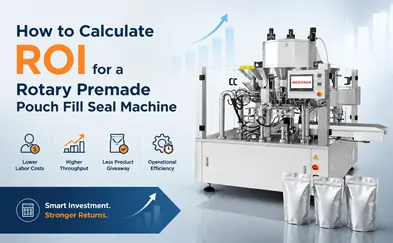
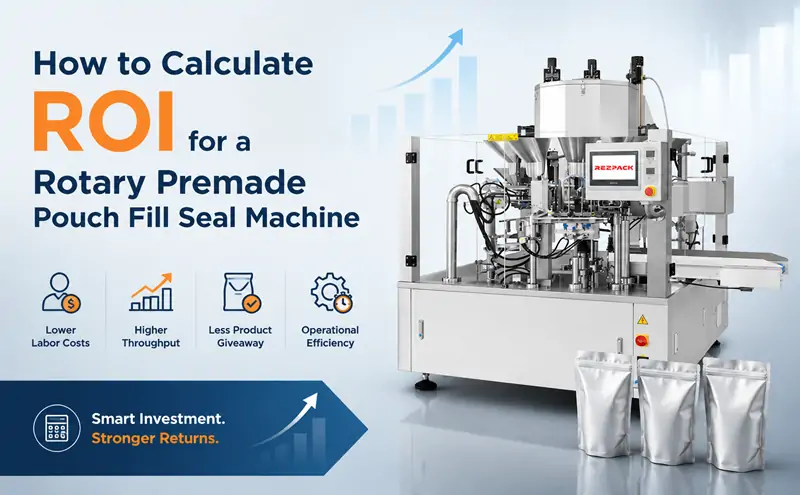
A packaging line manager evaluating a rotary pouch filling system faces a familiar dilemma: the purchase price is concrete and immediate, while the financial benefits—faster throughput, fewer operators, less product giveaway—are projected and uncertain. This asymmetry causes many companies to delay automation investments or to choose equipment based on the lowest upfront cost rather than the best long-term return. Both decisions can cost more than the machine itself over a typical service life of 10 to 15 years.
Calculating ROI for packaging equipment is not about finding a single definitive number. It is about building a model that compares two scenarios—the current operation and the proposed automated line—over a defined period, using assumptions that can be tested and adjusted as real data becomes available. This guide identifies the cost and benefit categories that matter most for a rotary premade pouch fill seal machine, provides reference ranges where applicable, and explains how to structure the calculation so the results can inform a purchasing decision.
Labor: The Largest and Most Immediate Saving
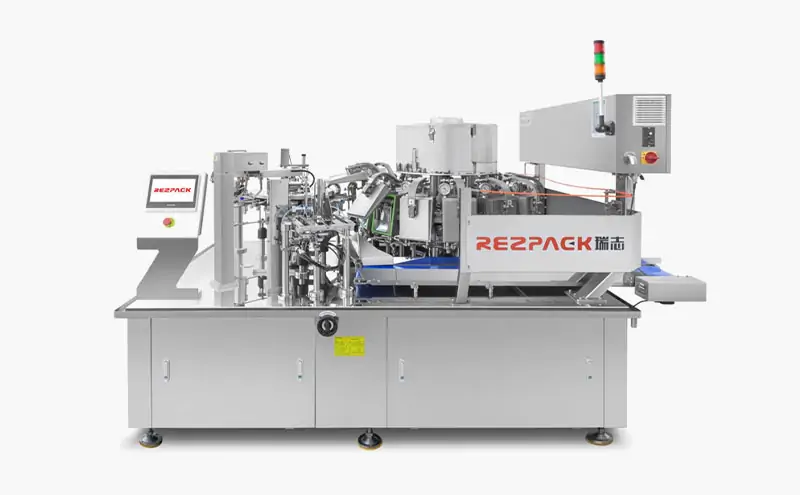
For most packaging operations, direct labor reduction is the single largest contributor to ROI. A semi-automatic or manual pouch filling process typically requires one operator per filling station. A rotary automatic machine consolidates multiple stations—bag feeding, opening, filling, sealing, and discharge—into a single piece of equipment that one operator can oversee.
To calculate the labor saving, start with the fully loaded hourly cost per operator, which includes wages, benefits, payroll taxes, and any shift premiums. In many manufacturing regions, this ranges from $15 to $30 per hour per operator when all costs are included. Multiply by the number of shifts per day and operating days per year.
Example: a line currently using 3 operators per shift across 2 shifts, 250 days per year, at a fully loaded cost of $22 per hour per operator, spends approximately $264,000 per year on direct labor for pouch filling. If automation reduces this to 1 operator per shift, the annual saving is $176,000.
Even in regions with lower labor costs, the calculation holds—the ratio of labor cost to equipment cost determines the payback period, not the absolute dollar amount.
Throughput: Making More Product in the Same Time
A rotary machine operates on a continuous indexing motion. While one station is filling, another is sealing, and a third is discharging a completed pouch. This parallel processing means the machine's maximum speed—often 60 to 100 pouches per minute depending on the model and product—can be sustained across an entire shift with only brief interruptions for material replenishment.
The financial value of higher throughput depends on whether the business is constrained by production capacity or by market demand:
If the business is production-constrained—meaning it could sell more product if it could make more—then additional throughput directly translates to additional revenue and margin. A machine that increases pouch output from 30 per minute to 80 per minute effectively allows the company to produce and sell 167% more product from the same packaging line.
If the business is demand-constrained—meaning sales volumes are fixed by orders—then throughput gains translate to reduced operating hours. The same daily volume can be produced in fewer shifts, reducing labor, utilities, and equipment run time.
For facilities running multiple shifts, high-speed premade bag filling equipment can consolidate production from two shifts into one, or from a six-day week into a five-day week, generating savings beyond direct labor.
Product Giveaway: The Hidden Margin Erosion
Every fraction of a gram over the labeled weight is product given away for free. On a manual or semi-automatic filling line, operators often overfill to avoid underweight rejects, and the average giveaway can range from 2% to 5% of the target fill weight. An automated rotary machine with integrated multi-head weighing or auger filling typically reduces giveaway to 0.5% to 1% through precise weight control and automatic feedback adjustment.
To calculate the value of reduced giveaway: multiply the annual production volume by the reduction in giveaway percentage, then multiply by the cost of goods sold per unit of product.
Example: a facility producing 5 million pouches per year with an average fill of 200 grams and a product cost of $3 per kilogram reduces giveaway from 3% to 1%. The annual product saving is approximately $60,000—saving that drops directly to the bottom line without any increase in sales volume.
Material Waste: Film, Pouches, and Rejects
Pre-made pouches represent a significant material cost. Manual handling produces a higher rate of damaged or misloaded pouches that must be scrapped. A rotary machine with no-pouch/no-fill detection and precise bag opening control reduces pouch waste by avoiding mis-feeds and incomplete fills that would otherwise generate rejected product.
A reduction in pouch waste from 3% to under 1% on an annual pouch spend of $150,000 saves approximately $3,000 to $4,500 per year. This is a smaller line item than labor or giveaway, but in tight-margin businesses, it contributes meaningfully to the overall return.
Changeover Time: The Cost of Flexibility
A packaging line that runs the same pouch size and product week after week captures the full throughput benefit of automation. A line that changes pouch sizes three times per shift loses production time during each changeover. The speed of changeover therefore affects the achievable output.
Modern rotary machines reduce changeover time through adjustable bag clamps controlled via touch screen, stored recipe settings, and tool-free width adjustments. A changeover that takes 30 minutes on an older machine may take 5 minutes on equipment designed for quick size changes. Over a year of multiple daily changeovers, the recovered production time can represent tens of thousands of dollars in additional output capacity.
Building the ROI Calculation
The ROI formula itself is straightforward:
Annual Net Benefit = Labor Savings + Throughput Value + Giveaway Reduction + Material Waste Reduction – Additional Costs (maintenance, utilities, financing)
Simple Payback Period = Total Equipment Investment ÷ Annual Net Benefit
For a packaging line with a $180,000 annual net benefit on a $250,000 equipment investment, the simple payback is approximately 1.4 years. More sophisticated analyses use discounted cash flow to account for the time value of money, but the simple payback provides a clear first-pass decision metric.
Testing the Assumptions
No ROI projection survives contact with reality unchanged. The value of the calculation is not the final number but the framework it provides for understanding which factors drive the return. If a 10% improvement in giveaway reduction has twice the impact of a 10% increase in throughput, that insight focuses attention on filling accuracy during equipment evaluation.
When evaluating equipment options, requesting rotary pouch packing machinery specifications and performance data allows the ROI model to be built on manufacturer-tested throughput rates and giveaway performance rather than generic industry averages.
Disclaimer
The ROI calculation framework and reference ranges provided in this article are for informational and educational purposes only. Actual costs, savings, and payback periods vary significantly based on product characteristics, labor rates, production volumes, facility conditions, and equipment configuration. This article does not constitute financial, investment, or purchasing advice. Companies should conduct their own ROI analysis using their specific operational data and consult with qualified financial professionals before making capital equipment purchasing decisions.


 English
 Pусский
 Español